Wood-Fired Hot Tub Planning Guide
A wood-fired hot tub commonly needs a few hours to heat from a cold fill. For preliminary planning, about 2–4 hours is a useful market range, but it is not a universal specification or a HACHILL model guarantee. Actual time depends on usable water volume, starting and target temperature, stove and circulation design, dry fuel, insulation, cover use, wind and ambient conditions. Use the exact tub-and-stove test conditions—not a generic headline time—when comparing models or planning a commercial operating schedule.
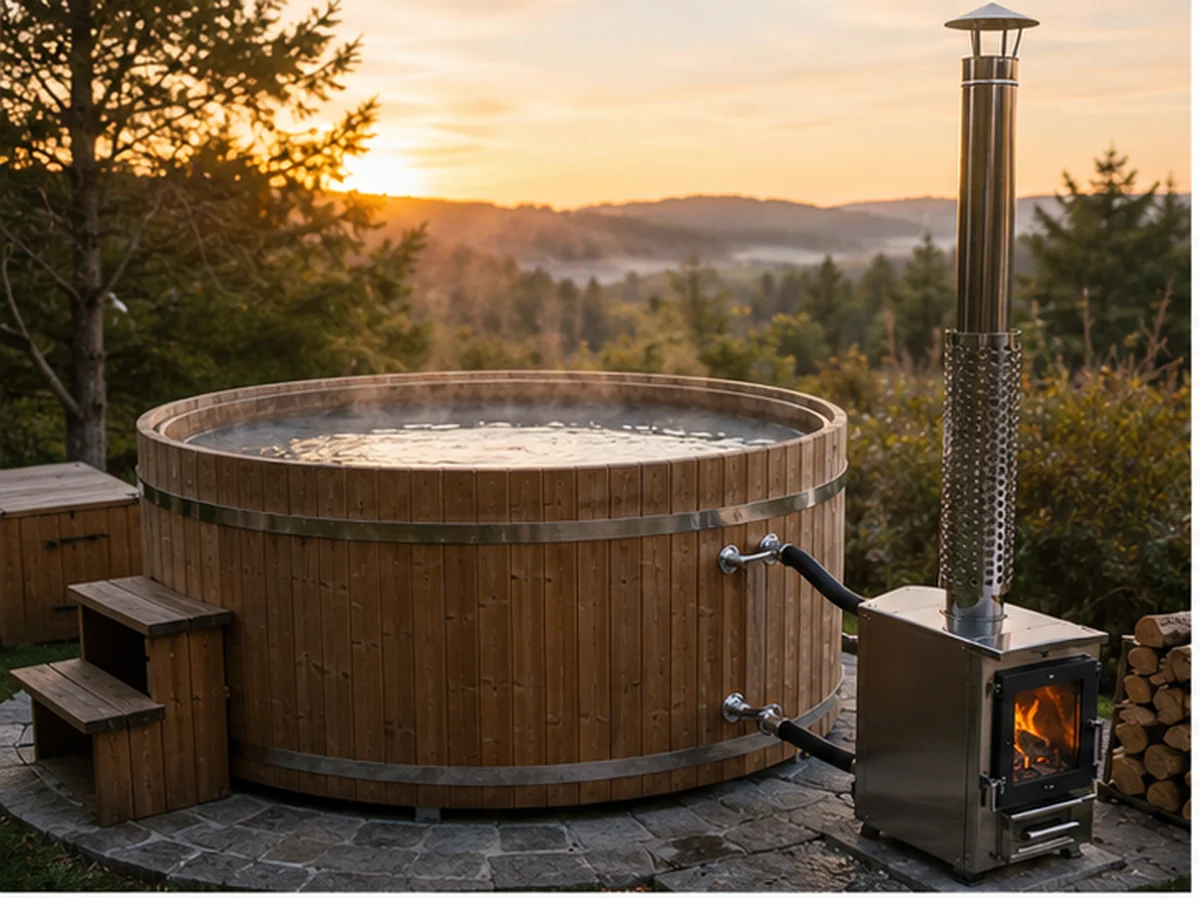
Conceptual visualization; not a verified HACHILL model or performance test.
Quick Answer
For preliminary planning, a wood-fired hot tub is often treated as a 2–4 hour heating task, but real systems can fall outside that range. The figure is only useful when the water volume, starting temperature, target temperature, stove configuration, circulation route, fuel condition and weather are known. A smaller tub with mild fill water and low heat loss may heat sooner; a high-volume winter installation with cold water, wet fuel, wind exposure or weak circulation may take much longer.
- Usable water volume and required temperature rise
- Exact stove, heat-transfer and circulation route
- Approved dry fuel and stable combustion
- Cover, insulation and exposed pipework
- Ambient temperature, wind and operating method
Confirm any heating-time figure against the selected model, approved configuration and documented test conditions. Buyers should also compare the available wood-fired hot tub range before requesting a model-level estimate.
For document-control, configuration evidence and release-gate requirements, use the Wood-Fired Hot Tub Safety Documentation Buyer Guide. This page remains the owner for heating-time estimation and heating variables.
When a Heating-Time Estimate Is Useful—and When It Is Not
Useful for planning
- Compare water volume and temperature rise.
- Allow a realistic preparation window.
- Adjust for winter or exposed sites.
- Compare supplier test conditions.
Not sufficient for approval
- Stove-to-tub matching
- Chimney, clearance or fire compliance
- Final circulation and installation design
- Commercial hygiene or staffing suitability
Decision boundary: use an estimate to screen options and prepare questions. Release a purchase order only after the exact tub, stove, circulation, site conditions and evidence scope are confirmed.
How Long Does a Wood-Fired Hot Tub Take to Heat?
A practical planning answer is about 2–4 hours for many wood-fired systems, but that is a screening range rather than a transferable specification. Published model examples vary because tub size, water volume, stove design and test conditions differ. A compact tub with moderate-temperature fill water, dry fuel, low wind exposure and an effective heat-transfer route may heat sooner; a larger tub filled with very cold water during winter may take substantially longer. Treat every model-level claim as condition-dependent and verify the water volume, temperature rise, configuration and test method behind it.
A Typical Range Is Only a Starting Point
A heating-time statement becomes useful only when the conditions behind it are known:
- Usable water volume
- Starting mixed-water temperature
- Target mixed-water temperature
- Ambient temperature and wind
- Exact stove and tub configuration
- Fuel type and moisture condition
- Cover and insulation condition
- Circulation and measurement method
Cold-Fill Heating and Reheating Are Different Tasks
Heating freshly filled water from 8°C to 38°C requires a 30°C temperature rise. Reheating retained water from 25°C to 38°C requires only 13°C. Even with the same tub and stove, the thermal task is therefore different. Adding cold water after cleaning, evaporation or bather use can also extend the recovery period.
Define When the Heating Test Begins and Ends
- Measure the mixed starting-water temperature.
- Record the usable filled volume.
- Light the stove using the approved procedure.
- Operate the system under documented conditions.
- Mix or circulate the water as instructed.
- Measure the final mixed-water temperature.
A hot layer near the surface or a high temperature near the stove outlet does not prove that the complete tub has reached the target temperature.
Why There Is No Universal Wood-Fired Hot Tub Heating Time
Heating time is governed by two separate quantities: the energy required by the water and the average net heat actually transferred into that water. NIST liquid-water heat-capacity data supports a planning approximation of about 4.18 kJ/kg·K near normal hot-tub temperatures.
Planning formula: water-heating energy in kWh ≈ water volume in litres × temperature rise in °C × 0.00116. This uses roughly 1 kg of water per litre as a practical estimating assumption.
The calculation estimates energy absorbed by the water only. It does not automatically include chimney losses, radiation from the stove and pipework, heat escaping through the tub and water surface, changing combustion, wet fuel, unstable circulation or outdoor exposure.
Illustrative calculation: A hypothetical 1,200-litre tub heated from 10°C to 38°C has a 28°C temperature rise and needs about 39 kWh of theoretical water energy. If measured average net heat transfer to the water were 15 kW, the idealized result would be about 2.6 hours; at 10 kW net, about 3.9 hours. Those net-power figures are calculation examples, not typical stove ratings or HACHILL model data. Real heat-up time can be longer because losses and combustion vary throughout the firing cycle.
Usable Water Volume Matters More Than Seat Count
Two tubs intended for the same number of users may have different internal dimensions, bench displacement, fill lines, stove displacement and actual filled water volume. Estimate from the approved usable water volume, not only external dimensions or nominal person capacity.
Rated Stove Output Is Not Delivered Water Heating
Useful transfer depends on the complete system: firebox and exchanger geometry, water-contact surface, combustion condition, chimney draft, circulation, pipe arrangement, water temperature, heat loss and maintenance. Ask whether a published heating time comes from a complete tub-and-stove test or only a nominal stove value.
The Variables That Change Wood-Fired Hot Tub Heat-Up Time
On smaller screens, swipe horizontally to view the full table.
| Variable | What to Confirm | Why It Changes Heating Time |
|---|---|---|
| Usable water volume | Actual litres or gallons at the operating fill line | More water requires more energy |
| Starting temperature | Mixed-water temperature before lighting | Colder water requires a larger temperature rise |
| Target temperature | Intended final mixed-water temperature | A higher target increases energy demand |
| Stove configuration | Exact approved stove, exchanger and tub combination | Defines the heat-transfer route |
| Circulation | Natural circulation, approved pump or manual mixing | Affects heat transfer and temperature uniformity |
| Fuel condition | Approved fuel type, moisture and piece size | Affects combustion stability and useful heat |
| Chimney draft | Approved flue arrangement and unobstructed airflow | Affects combustion performance |
| Cover and insulation | Exact configuration and permitted use during heating | Changes surface and envelope heat loss |
| Weather | Ambient temperature, wind and precipitation | Changes external heat loss |
| Maintenance | Clean heat-transfer surfaces and unrestricted flow | Fouling and restrictions may reduce performance |
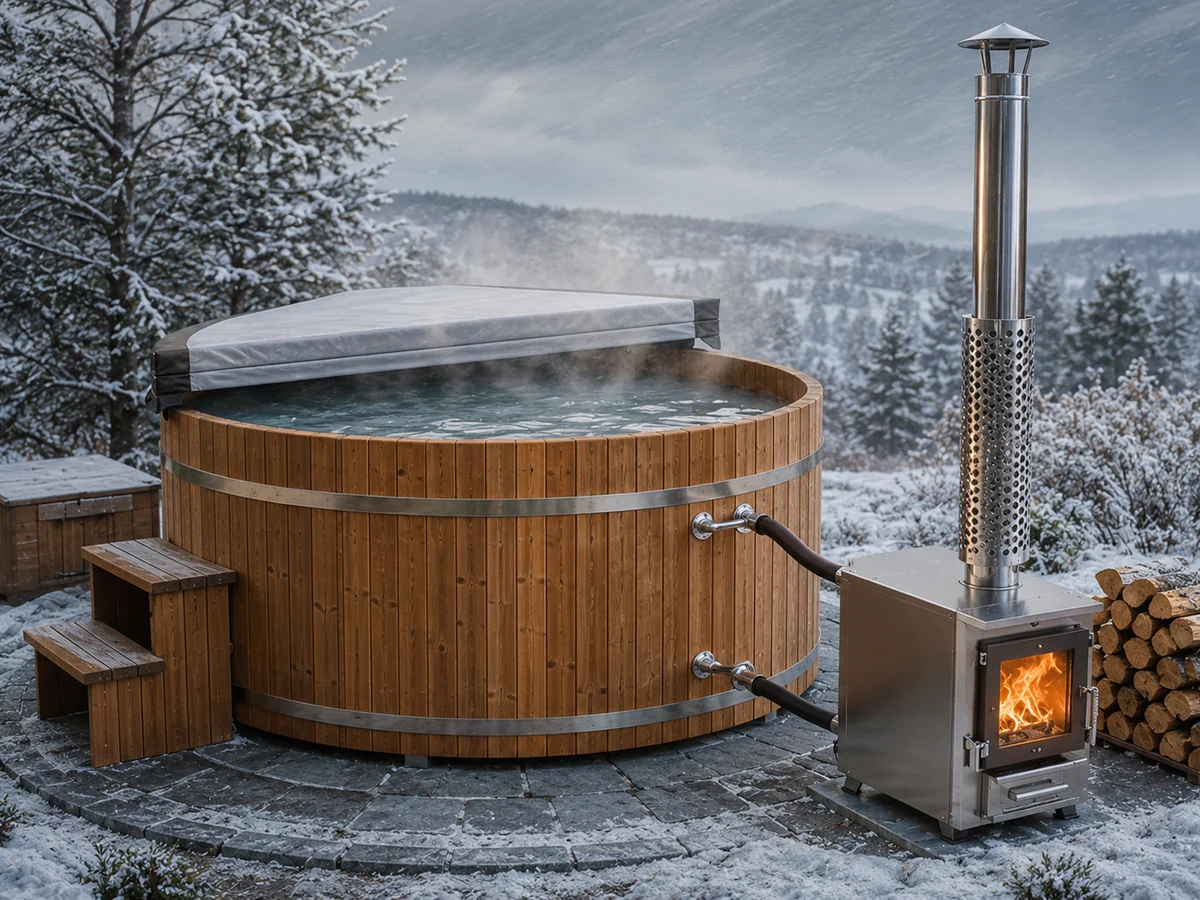
Conceptual winter operating scene; not a verified HACHILL model test or universal heating-time result. The cover position is illustrative only and must follow the selected product instructions and safe stove and chimney clearances.
Water Volume and Temperature Rise
Water volume and required temperature rise create the basic heating load. Record the actual source-water temperature in winter instead of applying summer data unchanged.
Stove and Heat-Transfer Route
Internal, external and other approved heat-exchange arrangements have different flow paths, water displacement, pipe exposure and maintenance requirements. Neither route is automatically faster in every configuration.
Circulation and Temperature Stratification
Natural-circulation systems depend on temperature differences, pipe position, slope and unrestricted flow. Approved pumped systems depend on pump selection and piping resistance. Do not add a pump to a natural-circulation system unless the manufacturer has approved the modification.
Fuel Quality and Combustion Control
Wet fuel consumes part of the fire’s energy evaporating moisture instead of heating the water. Use only fuel permitted by the stove instructions and local rules. Do not burn painted or treated timber, bonded board, household waste or fuels excluded by the manufacturer.
Cover, Insulation and Heat Loss
A compatible insulated cover may reduce surface heat loss, but it must not create a clearance or fire risk around the stove or chimney. Exact construction and permitted use during heating must be verified.
Weather, Wind and Seasonal Conditions
Cold air and wind increase heat loss. Site planning should account for winter temperature, wind exposure, precipitation, fuel storage, cover storage, freeze protection, drain-down procedures and safe access around the combustion equipment.
How to Estimate Heating Time Before Lighting the Stove
1. Confirm Usable Water Volume
Use the selected model’s approved fill volume. Do not substitute the external tub volume without accounting for benches, stove displacement, wall geometry and operating fill line.
2. Measure the Temperature Rise
Record the starting mixed-water temperature, intended target temperature and the difference between them.
Because the heating load depends on the endpoint, review how to select and verify the mixed-water target temperature. For general public-health context, the CDC advises that hot-tub water should not exceed 40°C (104°F); the actual project target may need to be lower.
3. Identify the Approved Configuration
Confirm the stove route, circulation method, pipe arrangement, chimney, fuel, cover and temperature measurement method.
4. Apply Real Site Conditions
Include ambient temperature, wind, fuel moisture, cold-fill versus reheat, cover use and any cleaning or refill requirement.
5. Add an Operating Margin
A scheduled operation should allow time for filling, ignition, stable circulation, mixing, temperature verification, cleaning checks, water-care checks where applicable and safe reduction of combustion intensity.
Use the right evidence level: a theoretical calculation checks broad plausibility; a controlled model test establishes a baseline for one approved configuration; repeated site records are the best basis for day-to-day scheduling. Keep the fill line, mixing method and measurement locations consistent.
Internal and External Stoves Affect the Heating System Differently
On smaller screens, swipe horizontally to view the full table.
| Consideration | Internal Stove | External Stove |
|---|---|---|
| Heat path | Integrated with the tub water | Heat transferred through external connections |
| Water displacement | May reduce usable water volume | Usually outside the bathing area |
| Bather protection | Requires protection from hot surfaces | Firebox can be separated from bathers |
| Circulation dependency | Depends on exact internal design | Strongly affected by pipe layout and elevation |
| External heat loss | May use fewer external water connections | Pipework and stove casing can add losses |
| Heating-time conclusion | Must be based on the complete model | Must be based on the complete installed circuit |
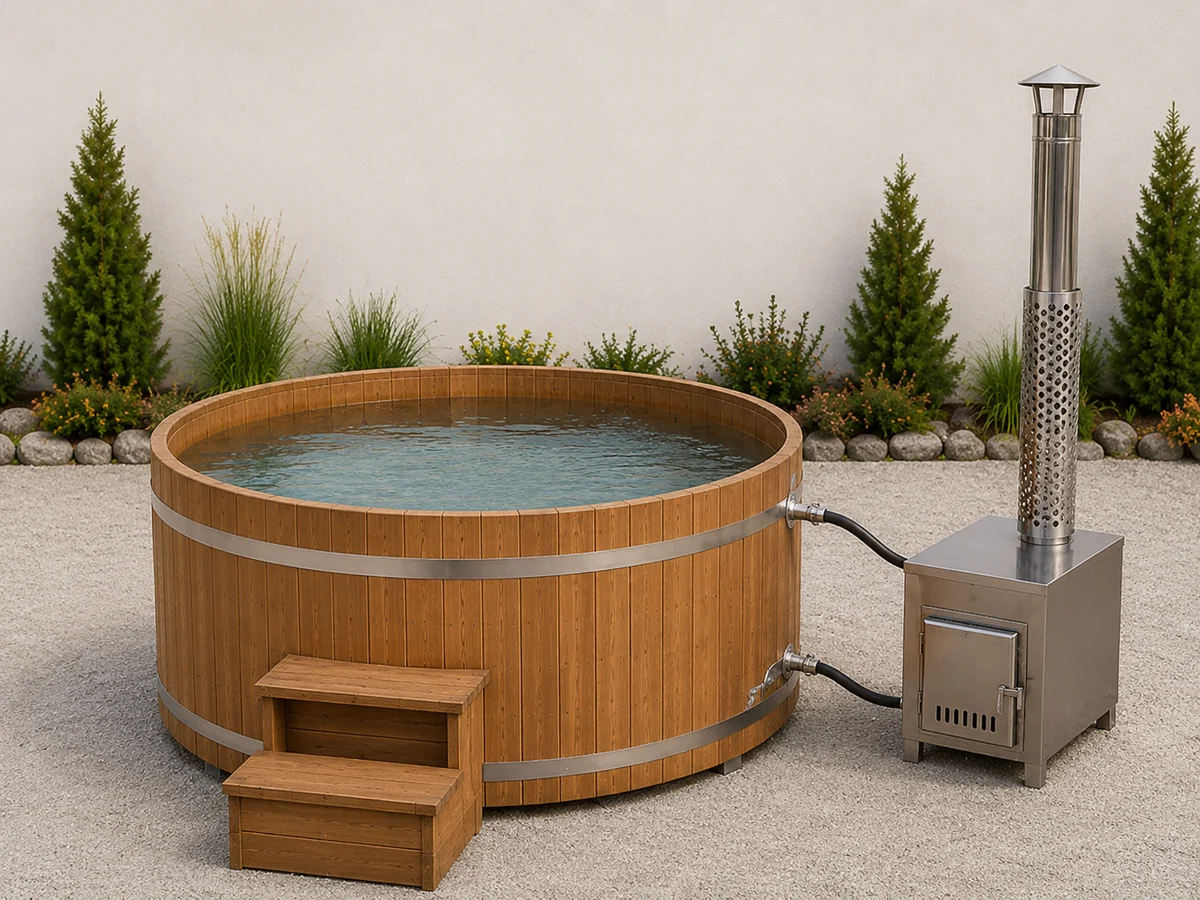
Conceptual external-stove configuration; connection geometry, chimney and clearances must follow the selected product documents and local requirements.
The correct route is not determined by heating time alone. User access, usable water volume, cleaning, available space, combustion separation, foundation, pipe layout, maintenance and local fire requirements also affect the choice.
For the broader round-format commercial buying decision, including seating, site fit, water care and quotation scope, use the Round Wood-Fired Hot Tub Buying Guide.
For the complete relationship between combustion, thermosiphon or approved pumped circulation, chimney draft and mixed-water temperature, review how wood-burning hot tubs transfer heat.
Site and Installation Inputs That Affect Heating
Heating performance cannot be separated from installation. Confirm these inputs before applying a test result to a real project:
- Foundation and level: support the filled load and preserve the approved stove and pipe geometry.
- Pipe route: verify connection height, slope, diameter and length for the selected system.
- Chimney and draft: use approved components and comply with local fire and smoke requirements.
- Drainage and refill: include the effect of cleaning, partial refill and source-water temperature.
- Freeze conditions: define drain-down, storage and seasonal shutdown procedures.
Final foundation, chimney, combustion, drainage and public-use requirements must be reviewed by the local installer and competent authority.
Seasonal and Operating Scenarios
Illustrative residential scenario
Mild-Weather Cold Fill
A residential user fills a tub during mild weather with dry fuel and limited wind exposure. Heating may be faster than in colder or more exposed conditions, but the owner should still record the water volume, starting temperature and mixed final temperature before treating the result as repeatable.
Illustrative seasonal scenario
Winter Cold Fill
The same tub starts with colder water and greater heat loss. The correct response is to extend the operating window, protect fuel from moisture and review freeze-management procedures—not to overfire the stove.
Composite technical scenario
External-Stove Circulation Issue
The stove burns normally but the tub heats unevenly. Possible causes include air in the circuit, unsuitable connection geometry, restricted flow or inadequate mixing. The operator should follow the approved inspection procedure instead of altering pipework or adding a pump without manufacturer review.
Composite commercial scenario
Resort Opening-Time Planning
Staff allow only the estimated firing time and omit filling, ignition, mixing, temperature verification and water-care checks. The corrected schedule works backward from guest access and assigns a trained operator to each preparation stage.
These scenarios are illustrative composites and do not represent named HACHILL customer projects.
Safe Ways to Reduce Heating Time
The objective is to reduce avoidable heat loss and unstable combustion—not to push the equipment beyond its approved limits.
Prepare the Water Circuit Before Lighting
- Fill to the required operating level.
- Confirm heating surfaces and the water circuit are submerged as required.
- Open the approved circulation path.
- Check for visible blockage or leakage.
- Confirm the chimney and required clearances are ready.
- Follow the selected model’s start-up instructions.
Use Approved Dry Fuel
Use properly stored, dry fuel of a type and size permitted by the stove instructions. The US EPA’s archived Burn Wise guidance supports dry, seasoned wood and warns against burning coated, painted, pressure-treated or glued wood products and household waste. The EPA program stopped updating this material in 2025, so the selected stove instructions and current local rules remain controlling.
Control Heat Loss Without Creating a Fire Hazard
Where approved, use the correct insulated cover, protect exposed water pipework, maintain insulation and reduce wind exposure through safe site planning. Do not place improvised insulation or wind barriers near hot surfaces or flue components.
Mix and Measure Before Adding More Fuel
The stove and embers may continue transferring heat after the water approaches the operating target. Reduce firing intensity according to the instructions, allow circulation, mix where required and measure at a representative location before adding more fuel.
When Slow Heating May Indicate a Problem
A slower session is not always caused by cold weather. Compare the current session with the approved baseline and previous operating records.
On smaller screens, swipe horizontally to view the full table.
| Observed Condition | Possible Explanation | Safe Response |
|---|---|---|
| Weak or smoky combustion | Wet fuel, restricted air, ash build-up or poor draft | Use only approved routine checks; stop if smoke spills into the operating area. |
| Hot return but uneven tub temperature | Stratification, air lock or restricted circulation | Follow the approved mixing and circulation procedure; do not modify the pipework. |
| Heating time increases over repeated sessions | Fuel change, fouling, cover damage or measurement drift | Compare logs and perform only the approved maintenance tasks. |
| Overshoot, boiling, steam or violent water movement | Late fuel addition, blocked flow or unstable circulation | Prevent access and follow the manufacturer shutdown procedure. |
When the result is substantially slower than the verified baseline, follow the wood-fired hot tub heating troubleshooting sequence before adding more fuel or changing the circulation route.
Stop operation and obtain qualified assistance for blocked circulation, uncontrolled boiling, steam, leakage, smoke spillage, damaged flue components or structural movement.
What Heating-Time Evidence Should a Buyer Request?
On smaller screens, swipe horizontally to view the full table.
| Evidence Item | Why It Matters | Decision Supported |
|---|---|---|
| Exact tub and stove configuration | Prevents one model’s result being applied to another | Product comparison and quotation |
| Usable water volume and temperature rise | Defines the real heating load | Technical plausibility |
| Ambient conditions, cover and insulation | Shows the test’s heat-loss boundary | Site comparison |
| Fuel type, moisture and circulation method | Explains combustion and heat-transfer conditions | Repeatability review |
| Measurement method and test repetitions | Prevents a local hot spot or one-off result becoming the headline figure | Performance evidence |
| Approved drawings, component scope and responsibilities | Connects the performance claim to the purchased configuration | Purchase-order release and handover |
Model-level heating evidence should be reviewed together with the approved configuration, drawings, components and manufacturing and quality-control review.
A useful statement: under documented conditions, the exact tub-and-stove configuration heated the stated usable water volume from the recorded starting temperature to the recorded mixed-water temperature in the measured period.
A seat count, lifestyle image, generic category brochure or nominal stove rating is not sufficient evidence by itself.
Heating-Time Planning for Resorts and Commercial Venues
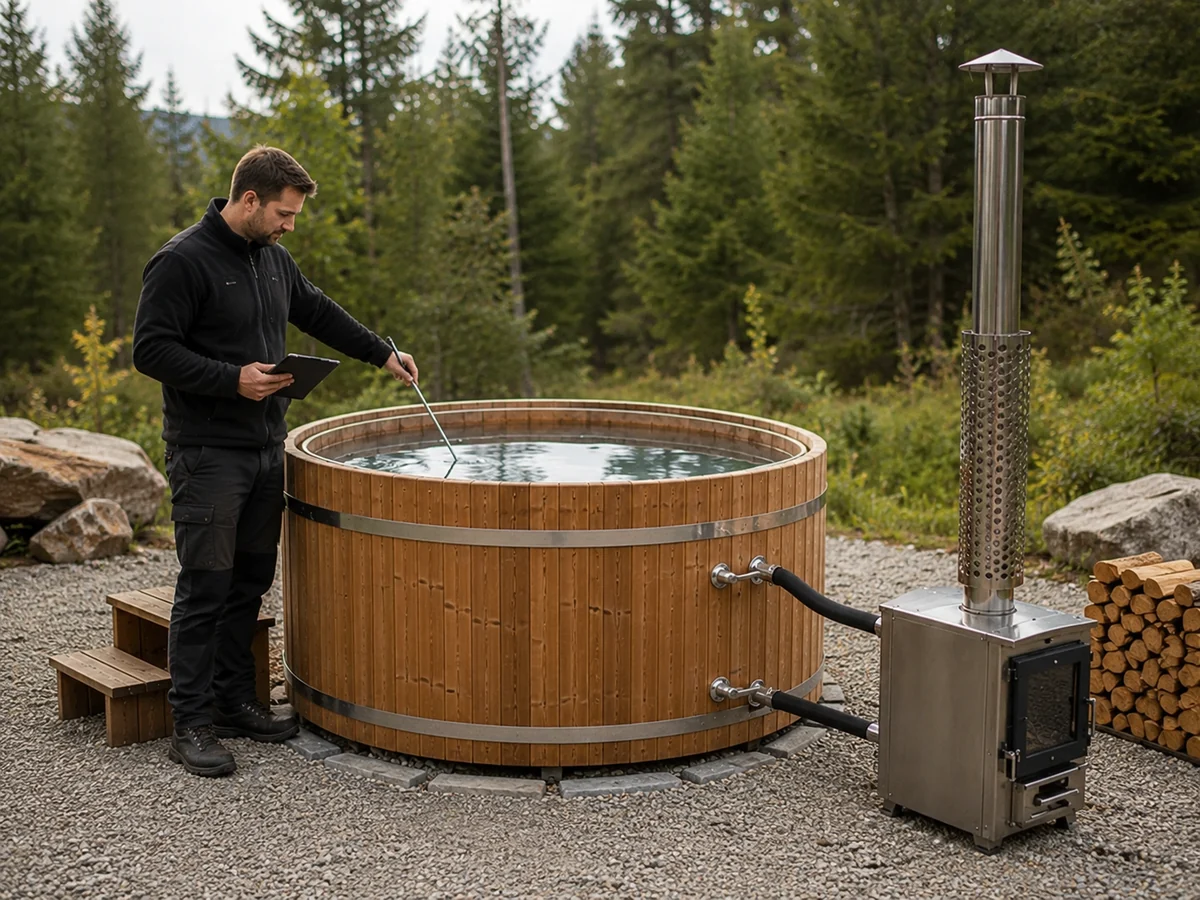
Conceptual operating scene; it does not represent a named customer site, approved commercial installation or specific HACHILL operating procedure.
Commercial buyers should coordinate heating time with guest flow, staffing, cleaning, utilities and handover through hotel and resort wellness project planning.
Work Backward from Opening Time
- Site and equipment inspection
- Water filling
- Fire preparation and ignition
- Heating
- Mixing and temperature verification
- Water-care checks
- Guest-access approval
- Monitoring during use
- Cleaning and shutdown
Define the Operator and Monitoring Procedure
Assign responsibility for fire management, temperature logging, fuel storage, water quality, cleaning, guest separation, emergency shutdown, ash handling and freeze procedures.
Confirm Whether Wood-Fired Operation Fits the Venue
On smaller screens, swipe horizontally to view the full table.
| Responsibility | Manufacturer / Supplier | Buyer / Venue | Installer / Local Professional |
|---|---|---|---|
| Approved product configuration | Provide confirmed model and component scope | Approve intended use and operating brief | Confirm compatibility with the site |
| Foundation and access | Provide known product dimensions and loads where available | Provide site data and delivery constraints | Design and verify the final foundation and handling route |
| Chimney and fire compliance | Provide product instructions and approved components | Identify venue and local requirements | Verify installation, clearances and approvals |
| Water care and commercial hygiene | State included equipment and product limitations | Define operating, cleaning and monitoring policy | Review local public-health and drainage requirements |
| Heating-time record | Provide model-level baseline when available | Maintain site logs and operating margins | Investigate installation-related deviation where applicable |
Define the Responsibility Boundary Before Handover
On smaller screens, swipe horizontally to view the full table.
| Operating Task | Key Inputs | Why It Matters |
|---|---|---|
| Initial cold fill | Full water volume, source-water temperature and opening time | Usually creates the largest single heating load |
| Temperature recovery | Bather load, exposure, partial refill and fire state | Determines whether repeated sessions are practical |
| Cleaning and refill | Water-care policy, drain volume and refill temperature | May create an additional daily heat-up cycle |
Separate Initial Heat-Up, Recovery and Daily Throughput
A wood-fired route requires additional review where the venue cannot provide trained operation, an approved chimney and clearance plan, secure fuel storage, smoke-compatible siting, reliable water care, guest separation, sufficient preparation time, freeze protection and required local approvals. These operating constraints may make another heating route more practical for some venues.
Heating-Time Checklist Before Purchase or First Use
- Exact tub model and configuration
- Exact stove and heat-transfer route
- Usable water volume
- Starting water temperature
- Intended target temperature
- Required total temperature rise
- Internal or external stove
- Natural or approved pumped circulation
- Approved fuel type
- Fuel moisture condition
- Cover and insulation configuration
- Ambient temperature and wind exposure
- Chimney and clearance review
- Foundation and drainage
- Freeze-management procedure
- Temperature-monitoring method
- Operator responsibility
- Supplier test conditions
- Local fire, smoke and installation requirements
Application: Residential, resort, spa or other commercial use
Capacity: Expected users, usable water volume and daily sessions
Climate: Summer and winter temperatures, wind and exposure
Heating Route: Internal or external stove and circulation preference
Site: Foundation, chimney, drainage, access and freeze plan
Fuel: Available approved wood type, storage and moisture control
Water Care: Fill, drain, cleaning, sanitation and refill routine
Commercial Duty: Opening time, trained operator, monitoring and recovery needs
Procurement: Quantity, branding, packaging, destination and document scope
Minimum Inputs for a Model-Level Review
Final selection depends on actual user capacity, usage frequency, installation environment, climate, foundation, fuel conditions, drainage, water-care routine, transport access, project requirements, local regulations and confirmed manufacturer data.
Evidence and Safety References
- NIST Chemistry WebBook: liquid-water heat capacity for the engineering basis of the preliminary water-energy calculation.
- CDC hot-tub safety guidance for the general 104°F (40°C) maximum-water-temperature safety context.
- US EPA archived Burn Wise practices for general dry-fuel and prohibited-fuel principles. The Burn Wise program stopped updating this material in 2025; current appliance instructions and local rules remain controlling.
These sources support general engineering or safety principles only. They do not establish a tested heating time, certification, installation approval or market compliance for any HACHILL model.
Decision summary:
- Estimate from usable water volume and required temperature rise.
- Evaluate the complete tub, stove and circulation configuration—not the stove rating alone.
- Add a site and operating margin for fuel, weather, cover use, mixing and verification.
- Request documented test conditions before accepting a model-level heating-time claim.
Frequently Asked Questions
How long does a wood-fired hot tub usually take to heat?
About 2–4 hours is a useful preliminary planning range for many systems, but it is not universal. Confirm the exact water volume, temperature rise, stove configuration, circulation route, fuel condition, weather and test method for the selected system.
Does a larger wood stove always heat a hot tub faster?
No. Heating time depends on the complete stove, exchanger, circulation and tub system. A larger nominal rating does not guarantee that more heat reaches the water safely.
Why does a wood-fired hot tub take longer to heat in winter?
Winter operation often combines colder fill water with greater heat loss from the water surface, walls and exposed components. Wind and wet fuel may extend the heating period further.
Does an internal stove heat faster than an external stove?
Not necessarily. Internal stoves have a short heat path, while external systems depend more heavily on connection and circulation design. Compare complete tested configurations rather than stove location alone.
Can a cover reduce heating time?
A compatible insulated cover may reduce surface heat loss. It must be used according to the product instructions and kept clear of unsafe stove or chimney conditions.
How can I estimate heating time from water volume?
Estimate the water energy from litres × temperature rise × 0.00116 kWh, then divide by a defensible estimate of average net heat delivered to the water—not the raw stove rating. Add margin for surface, pipe, tub and combustion losses.
What should a supplier include with a heating-time claim?
Request the exact model, usable water volume, starting and target temperature, ambient conditions, stove configuration, circulation method, fuel condition, cover status and measurement method.
Prepare a Wood-Fired Hot Tub Heating Brief
A qualified review needs more than a target heating time. Prepare the intended application, usable water volume, starting and target temperatures, climate, stove and circulation preference, fuel, foundation, chimney, drainage, water-care routine, delivery access and operating schedule.
For commercial or OEM projects, also provide daily throughput, staffing, destination market, quantity, branding, packaging and required technical or compliance documents.
Final heating performance, installation and commercial suitability must be confirmed for the selected model and approved project configuration.
Submit a wood-fired hot tub project brief
Technical scope and review boundary: This HACHILL guide explains wood-fired hot tub heating variables, preliminary heat-load estimation, operating conditions and B2B project inputs. It is not a model-specific installation manual or performance certificate. Exact water volume, stove configuration, heating performance, chimney, clearances, fuel, water care and commercial suitability must be confirmed for the selected product and destination market by the manufacturer, installer and relevant local professionals.